

Ramtech Building Systems is a leading provider of modular building systems including relocatable, permanent and prefabricated constructions.
T (817) 473-9376
Email: sale@viennavahouses.com
Ramtech Bulding Systems
1400 US Hwy 287 South Mansfield, TX 76063
Ramtech Blog
What Are the 2026 Top Prefab Business Building Types?
What Are the 2026 Top Prefab Business Building Types? The answer depends on speed, use, location, and long-term operating costs. A well-designed prefab business building can support offices, clinics, retail spaces, classrooms, restaurants, and compact production facilities. Each type serves a different commercial rhythm.
Industry evidence supports this broader adoption. McKinsey & Company estimated that modular construction could become a $130 billion annual market across Europe and the United States. Its research also identified potential cost savings of up to 20% and schedule reductions approaching 50% on suitable projects. These figures are not guaranteed. Site conditions, transport distances, design changes, and local approvals still matter. The Modular Building Institute’s permanent modular construction reports continue to track strong applications in education, healthcare, offices, and commercial facilities. Those sectors value predictable installation and repeatable quality.
In 2026, leading business types will likely include modular offices, medical clinics, retail units, hospitality buildings, and flexible warehouse offices. Imagine a two-story office arriving with finished wall panels, sealed windows, and factory-tested electrical systems. A roadside retail unit may need bright storefront glazing, efficient lighting, and rapid opening. A clinic requires stronger attention to ventilation, accessibility, privacy, and infection-control planning. The best choice is rarely the cheapest box. It is the building that fits the site and business model.
That judgment requires humility. Prefabrication can reduce disruption, but it cannot solve poor planning. Owners should compare lifecycle costs, energy performance, maintenance access, fire safety, and future expansion before ordering. Reports provide direction, not certainty. On-site experience remains essential.
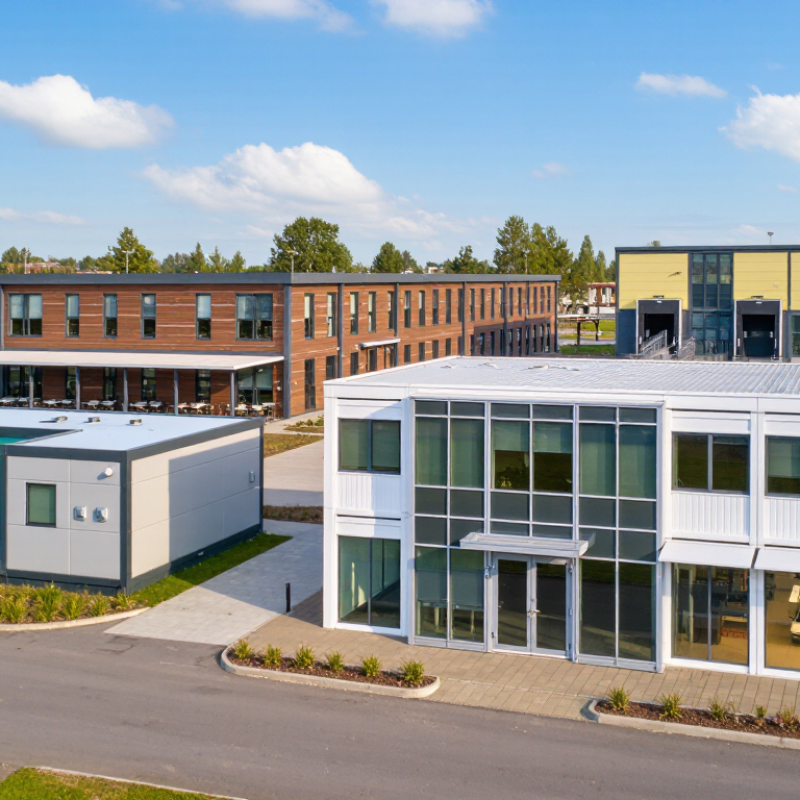
2026 Prefab Business Buildings: Definitions and MBI Market Data
Prefab business buildings are factory-produced structures assembled quickly on prepared sites. They include offices, retail units, clinics, restaurants, financial facilities, and workforce accommodation. Definitions matter. A modular building is manufactured in sections, then transported and joined on-site. A relocatable unit can move again, while permanent modular construction is designed for long-term occupancy.
For 2026, office buildings, healthcare clinics, education facilities, and small retail centers appear especially practical. They use repeatable floor plans, compact service cores, and factory-controlled finishes. A clinic may arrive with installed wiring, plumbing, washable wall panels, and exam rooms. An office module may include lighting, insulation, data pathways, and glazed meeting spaces.
The Modular Building Institute’s 2024 Permanent Modular Construction Annual Report estimated the North American market at about 12.4 billion dollars in 2023. That figure covers permanent modular construction, not every prefabricated product. The distinction is easy to miss. MBI data also shows commercial applications remain a major demand source, including offices, healthcare, hospitality, and education. Market estimates are useful, but they are not perfect forecasts. Local labor costs, transport limits, zoning rules, and site preparation can change the final value sharply. For buyers, the strongest 2026 building type may be the simplest one to repeat, approve, deliver, and maintain.
What Are the 2026 Top Prefab Business Building Types?
2026 Prefab Business Buildings: Definitions and MBI Market Data
| No. | Prefab Business Building Type | Definition | Typical Applications | Common Prefabricated Scope | Market Relevance and Selection Factors |
|---|---|---|---|---|---|
| 1 | Modular Office Buildings | Commercial workspaces manufactured partly or substantially away from the final site and assembled on a permanent foundation. | Corporate offices, branch offices, administrative centers, call centers and professional-service workplaces. | Volumetric room modules, wall panels, floors, ceilings, electrical systems, HVAC assemblies and interior finishes. | Often selected when organizations need predictable delivery, repeatable layouts, future expansion and reduced disruption at an operating site. |
| 2 | Retail and Service Buildings | Prefabricated structures designed for customer-facing sales, service or transaction activities. | Retail stores, financial-service locations, pharmacies, restaurants, cafés, showrooms and small service centers. | Structural modules or panels, storefront systems, service counters, lighting, plumbing and standardized interior packages. | Standardized designs support multi-location rollouts, while off-site production can shorten site activity and improve construction consistency. |
| 3 | Healthcare Facilities | Prefab buildings or building sections engineered for clinical, diagnostic, administrative or support functions. | Medical offices, outpatient clinics, urgent-care facilities, laboratories, pharmacies and healthcare support spaces. | Patient rooms, exam rooms, MEP systems, medical-gas coordination, infection-control finishes and accessibility features. | High value is associated with controlled production, repeatable quality, shorter on-site schedules and the ability to add capacity near existing facilities. |
| 4 | Education and Training Buildings | Permanent or relocatable prefab facilities used for instruction, administration or workforce development. | Classrooms, training centers, vocational facilities, libraries, laboratories, faculty offices and student-support areas. | Classroom modules, corridor sections, accessibility systems, acoustical assemblies, restrooms and technology infrastructure. | Useful where enrollment or training demand changes quickly and construction must be coordinated around an occupied campus. |
| 5 | Hospitality and Lodging Buildings | Prefab accommodation facilities in which guestrooms, corridors or complete building sections are manufactured off site. | Hotels, extended-stay properties, workforce lodging, guest facilities and temporary accommodation projects. | Finished guestroom modules, bathrooms, corridor modules, MEP connections, furniture packages and façade components. | Repetitive room layouts make this sector suitable for modular production, particularly when schedule certainty and consistent room quality are priorities. |
| 6 | Government and Public-Service Buildings | Prefab facilities used by public agencies for administration, operations or community services. | Municipal offices, public-safety facilities, inspection offices, community-service centers and operational buildings. | Office modules, secure rooms, public counters, meeting rooms, durable finishes and code-compliant accessibility systems. | Prefab delivery can support phased programs, constrained public sites and projects requiring transparent scheduling and repeatable specifications. |
| 7 | Industrial and Operations Buildings | Prefab business facilities supporting production, maintenance, logistics, field operations or specialized industrial services. | Operations offices, maintenance buildings, control rooms, laboratories, workshops and logistics-support spaces. | Steel or wood modules, insulated panels, equipment rooms, utility skids, control spaces and specialized interior assemblies. | Common selection factors include remote or constrained sites, the need for rapid deployment and integration with existing industrial operations. |
| 8 | Relocatable Commercial Buildings | Factory-built buildings intended to be moved, reused or deployed for a limited or changing period rather than remaining permanently at one site. | Temporary offices, site offices, classrooms, clinics, sales centers, workforce facilities and emergency-response buildings. | Transportable modules, standardized utility connections, durable finishes and configurations designed for disassembly or relocation. | Best suited to short-term capacity needs, phased development, emergency response or locations where a permanent building is not yet justified. |
Related Posts
-
10 Tips for Choosing a Prefab Commercial Building?
-

What Are Modular Construction Offices and How Do They Work?
-
2026 Best Outdoor Modular Office Building for Global Buyers
-
Top Modular Construction Offices Manufacturers Worldwide
-
Top Benefits of Modular Retail Buildings: Cost-Effective and Flexible Solutions
-
Why Choose Modular Retail Building for Your Next Business Venture?